
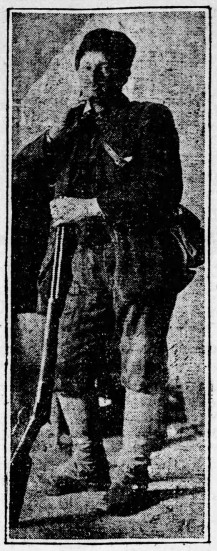
In April 1913, a traveler walked into the McHenry Plaindealer with quite a story. His name was Starl Cronley, and he was on his way to New Mexico, he stopped by to share his story. Starl, born in Ohio in December 1880, was a soldier in the U.S. Army and served in the Philippine-American War and was also stationed in Texas. It was while serving there that he started having epileptic seizures, sometimes having one every other day. He left the service in December 1903 after serving for three years. Besides having to leave the Army, the seizures were preventing him from finding steady employment. It was with that, he decided to give walking a try as a kind of medical treatment.
In October 1907, Cronley left Toledo, Ohio, on the bet of $2000 with some “sporting men” that he could walk the outer parameter of the country by June 1910. He started from Toledo, heading to the northernmost point in Maine. Then he went south along the Atlantic coast, rounding Florida, and headed west along the Mexican border. One of the key components of the bet was that Cronley wasn’t to steal or beg for any money that he needed. He was to work for his keep and often made money from drawings that he sold to people along the way. Overall, he noted that his health was indeed better while on his journey and only had a few seizures along the way. It was a good thing that he was able to keep his health, as the gentlemen who proposed the wager didn’t come through with the money on their end. Cronley didn’t find out until he arrived in Brownsville, Texas. Finding the improvement of his health and giving him a sense of purpose, Cronley decided to finish his journey. When he reached San Diego, Cronley headed north along the Pacific Coast until he came across the Canadian line. He then followed the Canadian border back home to Toledo on November 13, 1909. The grand total for that trip was 12,868 miles.
Originally, when he was collecting proof of location for his first bet, Conley would have the town Post Master sign an ever-increasing volume of ledgers. He estimated that he had about twelve hundred signatures by the end of the walk. It was also noted along his journeys that in appearance, he kept clean and didn’t look ragged. As he would travel, Starl got quite a bit of press coverage, as his adventures would come up in newspapers throughout the country. Yet, for all of the miles that were covered, Starl only had a few run-ins with the law. One was in New York where he inadvertently took up company with a pickpocket that the police were looking for. He was able to get out of that situation by showing the authorities his travel journals. While in Florida, a local sheriff took a liking to the rifle that Cronley carried for hunting and held him in jail until he relinquished the firearm. In one of the few instances of having a seizure, bandits took advantage of the situation to relieve Starl of some of his money. Overall, he said that a majority of the people he encountered were very friendly and were interested in what he was doing.
By the time he arrived in McHenry in 1913, Starl was heading to Marshaltown, Iowa, as he had heard that his father lived there. When he came to McHenry, Cronley was on his fourth such journey. For this trip, he was taking the trip for himself, while two others were going for money. The journey began in about 1911, when a company paid Cronley to walk across the country to serve as a pitchman for territory in New Mexico. Unfortunately, he had to give up that trip as his health was failing him, and he was unable to complete the trip. According to the 1920 census, Starl was back living in Toledo. Throughout the 1920s, he increasingly visited National Homes for Disabled Veterans for a variety of health issues. Cronley passed in Riverside, California, on 14 Jan 1931. He was buried in the Olivewood Cemetery. Roughly a year later, in February 1932, the Veterans Administration provided a marble tombstone for him.
Sources
- “Walker In Town.” The McHenry Plaindealer. (McHenry, IL) 10 Apr 1913, 1. Newspapers.com. Web. 17 Sep 2025.
- “Wager Walker Is Nearing His Goal.” The Duluth News Tribune. (Duluth, MN) 30 Apr 1909, 1. Newspapers.com. Web. 17 Sep 2025.
- “Staryl Cronley who is walking….” The Superior Times. (Superior, WI) 4 Sep 1909, 3. Newspapers.com. Web. 17 Sep 2025.
- “Tour Will Take Three Years.” Oakland Enquirer. (Oakland, CA) 9 Mar 1908, 1. Newspapers.com. Web. 17 Sep 2025.
- “Starl Cronley passed through….” Lincoln County Leader. (Toledo, OH) 2 Apr 1909, 1. Newspapers.com. Web. 17 Sep 2025.
- “Six Thousand Miles On Foot.” The Brownsville Daily Herald. (Brownsville, TX) 4 Sept 1908, 1. Newspapers.com. Web. 17 Sep 2025.
- “The Pedestrian Starl Cronley….” The Brownsville Daily Herald. (Brownsville, TX) 10 Apr 1913, 1. Newspapers.com. Web. 17 Sep 2025.
- “Walking Around the United States.” The Brownsville Daily Herald. (Brownsville, TX) 31 Aug 1908, 1. Newspapers.com. Web. 17 Sep 2025.
- “Walks For Health” Evening-Times Republican. (Marshalltown, IA) 6 Dec 1913, 9. Newspapers.com. Web. 17 Sep 2025.
- “Around the Union.” The Ocala Evening Star. (Ocala, FL) 25 Apr 1908, 3. Newspapers.com. Web. 17 Sep 2025.
- “Walks Around the Border of United States.” The Virginia Enterprise. (Virginia, MN) 27 Aug 1909, 1. Newspapers.com. Web. 17 Sep 2025.
- “Walks 7200 Miles On Wager Of $2000.” Los Angeles Herald. (Los Angeles, CA) 26 Dec 1908, 12. Newspapers.com. Web. 17 Sep 2025.
- “Weston Disciple Here.” New Ulm Review. (New Ulm, MN) 16 Jul 1913, 8. Newspapers.com. Web. 17 Sep 2025.
 MPLD Local History Blog
You must be logged in to post a comment.